The Penny Universities
In this lesson
- A small ritual to beginHow to read this: a coffee, a playlist, a pen.
- History: what was built at the tablesThe newspaper, the Stock Exchange, Lloyd's, all born here.
- Philosophy: the rule of the roomTake the next free seat. Rank stopped at the door.
- Literature: the paper made of talkThe newspaper, filed by coffeehouse.
- Music: the song for the roomBach wrote a comedy about a coffee addict.
- Art: look before you read onA room you have sat in, three hundred years old.
- Language: five small things to keepQahwa, caffeine, and a dish of coffee.
- History again: the dolphin on the tableNewton's friends, a dolphin, and the penny seat.
- Remember what you've learnedNo exam. Keep the line that stopped you.
Read one part at a time. Press Next when you are ready.
London, 1652. A churchyard alley off Cornhill, so narrow you could touch both walls at once.
There is a new smell in the alley, scorched and bitter, blowing from a shed built against the wall of St Michael's church. A crowd has gathered at the door. Inside, a servant named Pasqua Rosée is pouring a black drink from a pot into small dishes, and half the young men of the city are queuing to taste the strangest thing to reach London in a generation.
He hands each of them a printed sheet as they wait. It swears the drink will quicken the wits, dry up the gout, and keep a man from nodding off over his books. Most of the promises are nonsense.
One is not: this drink will make you chatty.
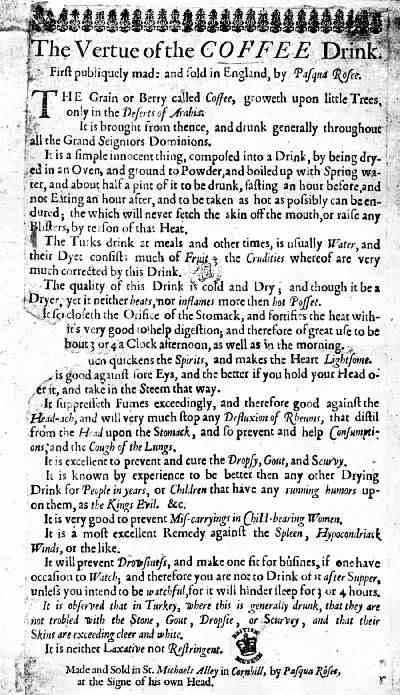
That shed is the first coffeehouse in London. Within a single lifetime there will be hundreds of them, then thousands, and the crowds who pack into them will build, at those wet tables, a startling share of the modern world: the newspaper, the stock exchange, the insurance market, and the beginnings of modern science.
The price of admission was a penny.
For that one coin you got a dish of coffee, the day's news sheets, a candle to read them by, and a seat at any table in the room, next to anyone at all. Londoners gave the coffeehouse a nickname that was half a joke and entirely true.
The penny university.
A small ritual to begin
Pour the right drink. Coffee tonight, not tea. Brew it in a pot if you have one and drink it from a real cup, the way they did. Put the phone in another room. Print the PDF if you can, and keep a pen close; the margins are yours to argue in.
Put on the music. Tonight's playlist ends with a piece that a composer wrote for a room exactly like the one we are about to enter: the playlist. Start it low. You will know the last song when it arrives, and why it is waiting there.
Copy what stops you. Somewhere in this lesson is a line you will want to keep. When you meet it, write it out by hand in your commonplace book. Handwriting is how a line becomes yours.
What is in the kit
Keep the lamp lit
Every lesson here is free, and stays free, because patrons pay for the wax that keeps the candles lit. Become a patron or founder to download the printable kit and the Anki deck, and to be the reason the next reader finds all of this open and free.
The lamp stays lit because you fill it.
Your study kit
Yours because you keep the lamp lit. Print it, work it, keep it.
History: what was built at the tables
Coffee did to London what nothing had before it. Wine and beer made you slower; this made you quick, and it kept you awake to argue past midnight. Within twenty years of Pasqua Rosée's shed there were coffeehouses on nearly every street of the old city, hundreds of them, and no two were quite the same.
Because a man came back to the house where he found his kind of talk, each one grew a specialty, the way a bar grows regulars.
At Will's in Covent Garden, the poets. John Dryden kept a chair by the fire, and a young writer's whole career could turn on being noticed there.
At the Grecian, near the law courts, the scholars and the scientists.
At Jonathan's and Garraway's in Exchange Alley, the men who traded shares. They had been thrown out of the Royal Exchange for being too loud, so they carried their business to the coffee tables, and in 1698 a broker named John Castaing began issuing a list of stock and commodity prices from a table at Jonathan's. That list is the ancestor of every ticker since.
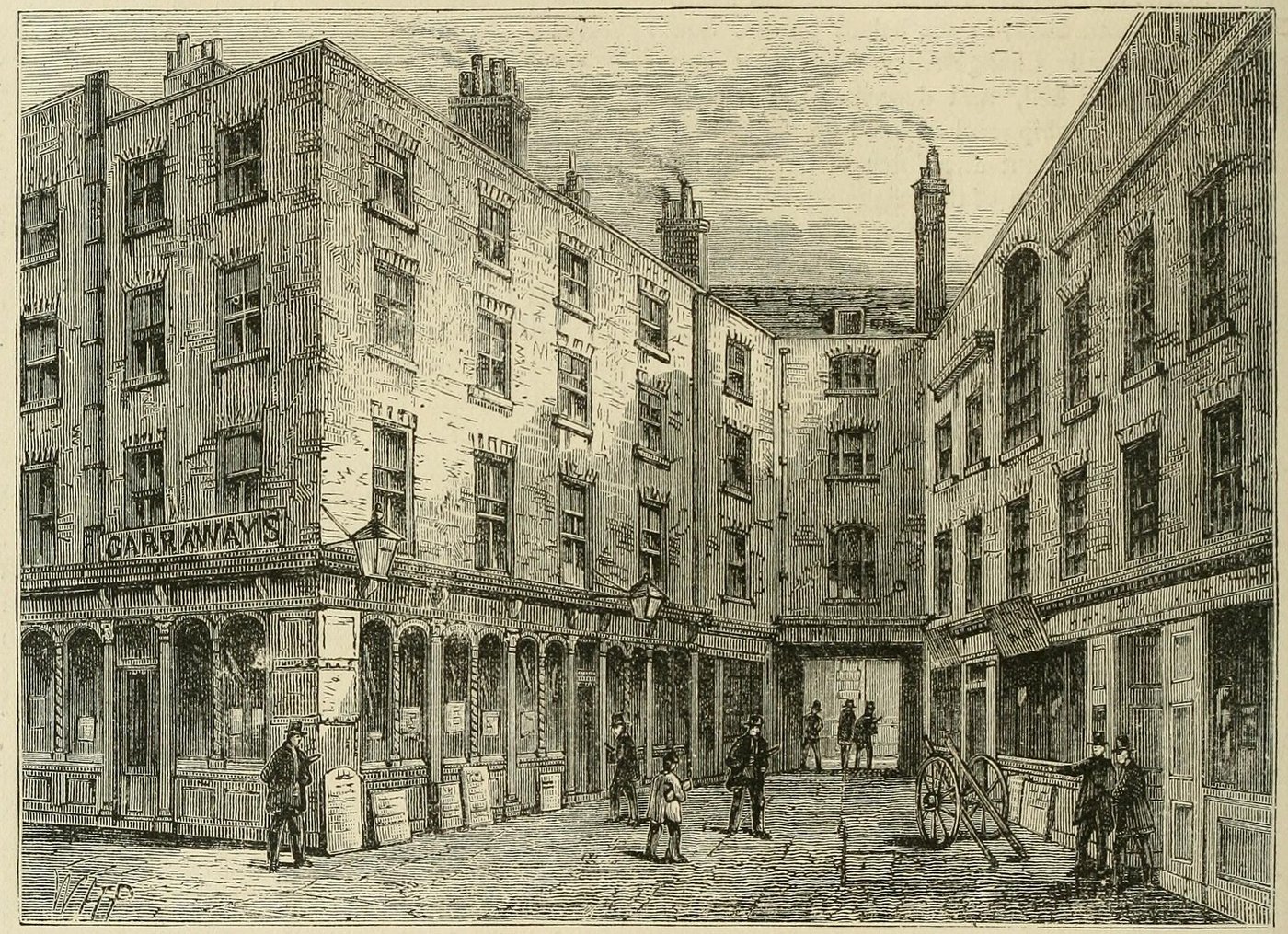
Jonathan's became the London Stock Exchange.
At a house kept by a man named Edward Lloyd, near the docks, the sailors and the shipowners and the men who gambled on whether a ship would come home. Lloyd kept a book of shipping news for his customers; the men who insured the voyages struck their deals at his tables.
The coffeehouse is gone.
Lloyd's of London is not.
The king noticed. In 1675, uneasy about what got said in rooms he could not hear, Charles II issued a proclamation to shut every coffeehouse in England, calling them nurseries of "false, malicious and scandalous" reports against his government. He was not wrong that they bred opinions. He was wrong that he could stop them.
The outcry came from every rank and trade at once. Eleven days after the ban was announced, the king quietly took it back.
Philosophy: the rule of the room
The strangest thing about the penny university was also the truest.
You could sit anywhere.
A duke came in and took the nearest free seat, even if it put him elbow to elbow with a porter, because the house had a rule and the rule was posted on the wall. Somebody in 1674 printed the rules in verse, and a copy survives:
First, gentry, tradesmen, all are welcome hither,
And may without affront sit down together...
Pre-eminence of place none here should mind,
But take the next fit seat that he can find.
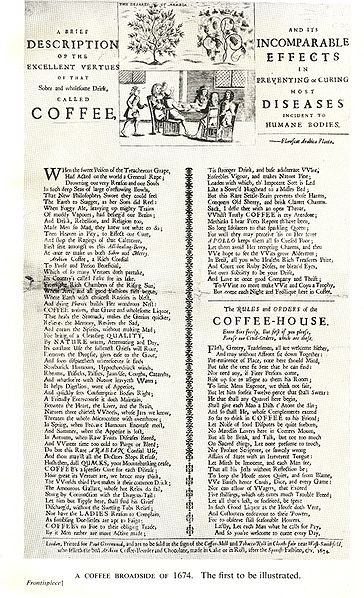
Outside, England ran on rank. Where you sat at dinner, who bowed to whom, which pew in church was yours: all of it fixed at birth and enforced by law. Inside, for a penny, it stopped at the door.
What grew in that small unfixed space was an idea so ordinary to us now that it is hard to feel how new it was: that the truth might be worked out by ordinary people, talking, instead of being handed down from a pulpit or a throne. Ideas were argued into being, by whoever showed up, over coffee, in public.
We now call it the Enlightenment.
Literature: the paper made of talk
The coffeehouses talked so much that the talk became the news.
In 1709 a writer named Richard Steele started a little paper called The Tatler, and he built it out of the coffeehouses directly. Each story would carry the name of the house it came from:
All accounts of gallantry, pleasure, and entertainment shall be under the article of White's Chocolate-house; poetry, under that of Will's Coffee-house; learning, under the title of the Grecian; and foreign and domestic news, you will have from the Saint James's Coffee-house.
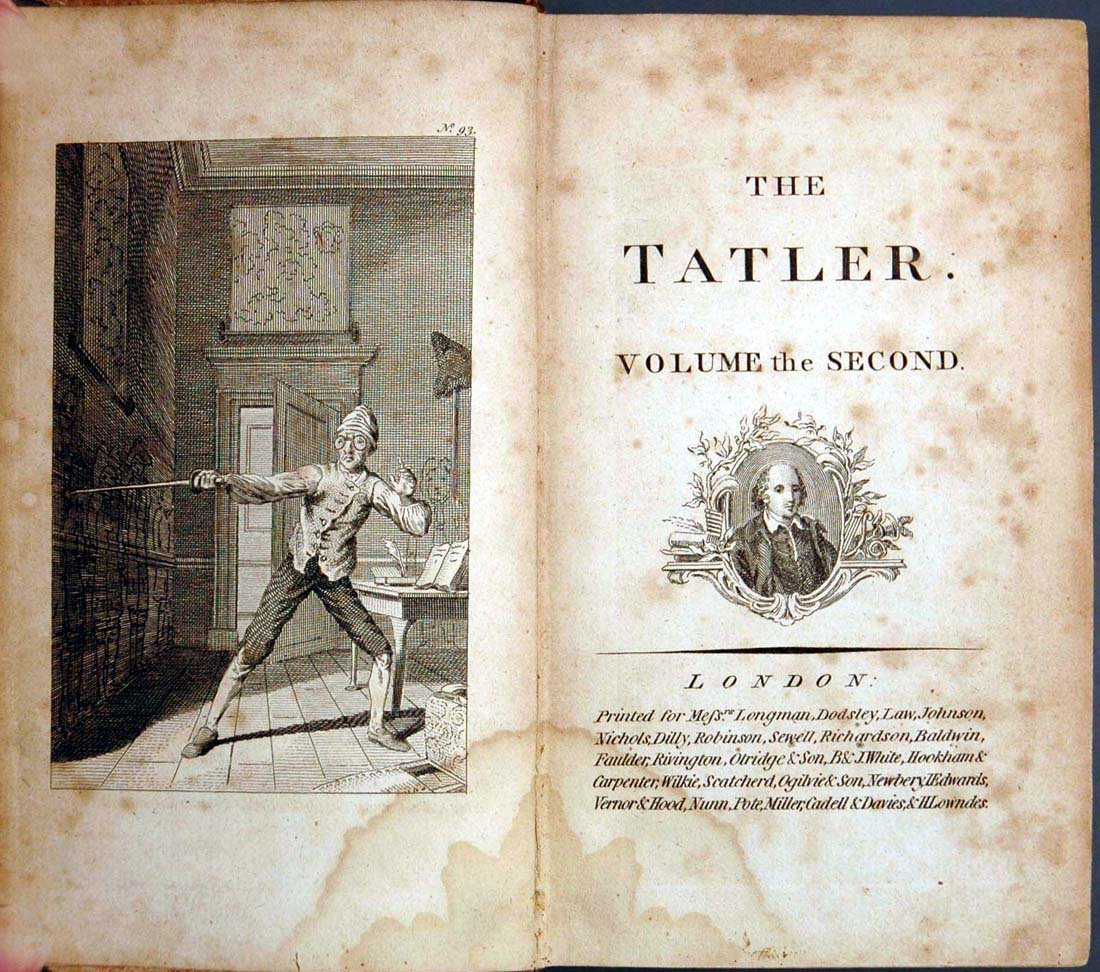
The newspaper was born in those coffeehouses.
Two years later, Steele and his friend Joseph Addison began The Spectator, and it went everywhere, one copy passed hand to hand or read aloud to a whole bench, so a single issue reached far more ears than it ever sold copies. Addison knew exactly what he was doing, and said so:
It was said of Socrates that he brought Philosophy down from Heaven, to inhabit among Men; and I shall be ambitious to have it said of me, that I have brought Philosophy out of Closets and Libraries, Schools and Colleges, to dwell in Clubs and Assemblies, at Tea-Tables, and in Coffee-Houses.
Philosophy out of the closet and onto the table. That was the whole project, and he ran it out of a coffee cup.
Music: the song for the room
We think of Johann Sebastian Bach in a cathedral: robes, a great organ, music built like a cathedral itself and written for God. All of that is Bach, but during evenings in Leipzig, for years, Bach put on ordinary clothes and walked to a coffeehouse called Zimmermann's, where he led a band of students and townsmen in concerts for whoever bought a cup.
Bach was the coffeehouse musician.
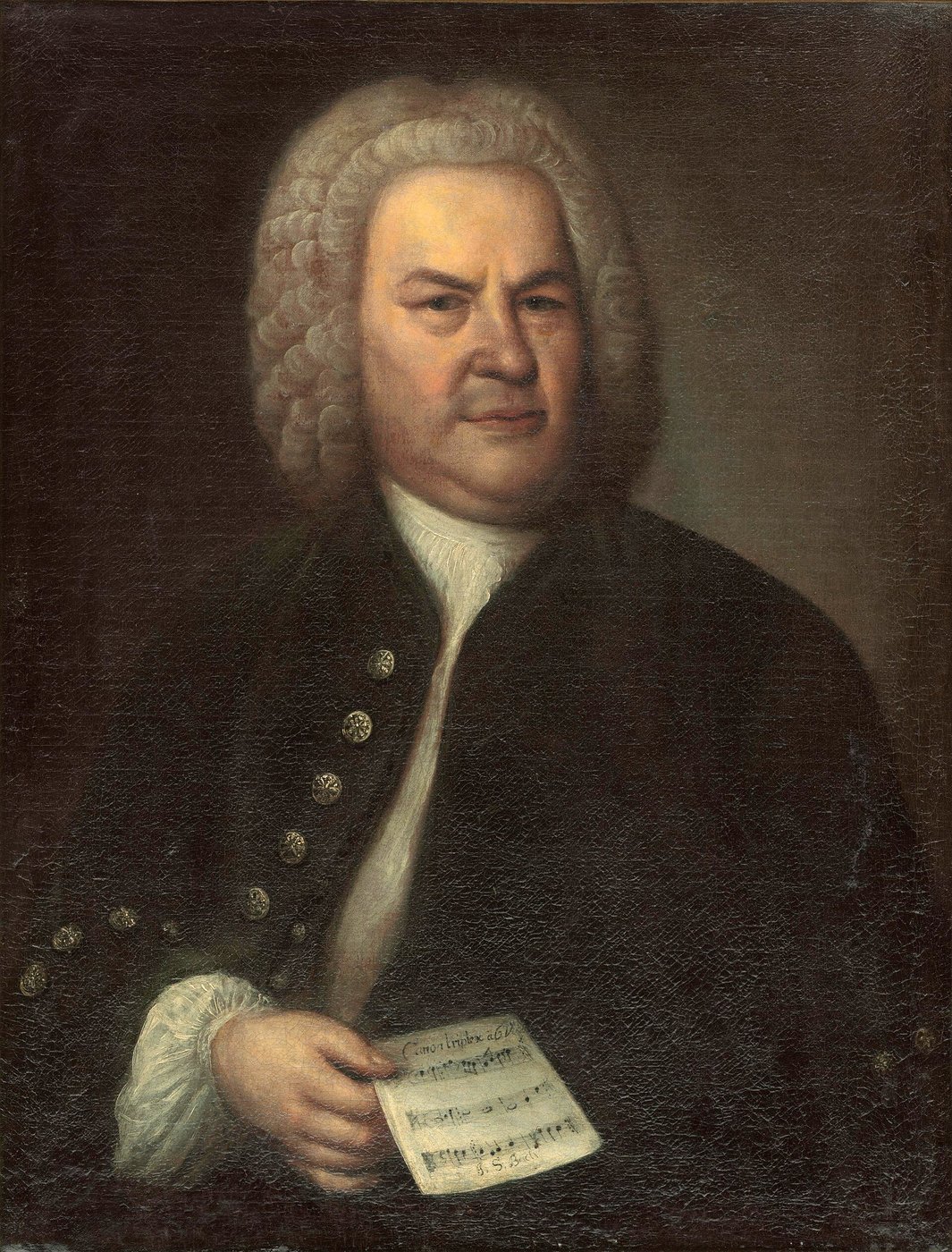
Around 1734, he wrote them a comedy.
It is a tiny opera about a father losing a fight with his daughter. Her sin is coffee. He threatens to take away her walks, her dresses, her wedding, and she will not give up the pot, and in the middle of the quarrel she sings the aria you are hearing now:
Ei! wie schmeckt der Coffee süße,
lieblicher als tausend Küsse,
milder als Muskatenwein.
Ah, how sweet the coffee tastes,
lovelier than a thousand kisses,
softer than muscatel wine.
I played and taught classical piano for years, and I still carry it around in my head that Bach composed in a church, but he wrote a jingle about a caffeine addict and conducted it himself in a room full of cups.
Art: look before you read on
Take a moment with this one before the words. Where does your eye land first? Look for the man reading aloud, and the woman behind the urn. And the dog!
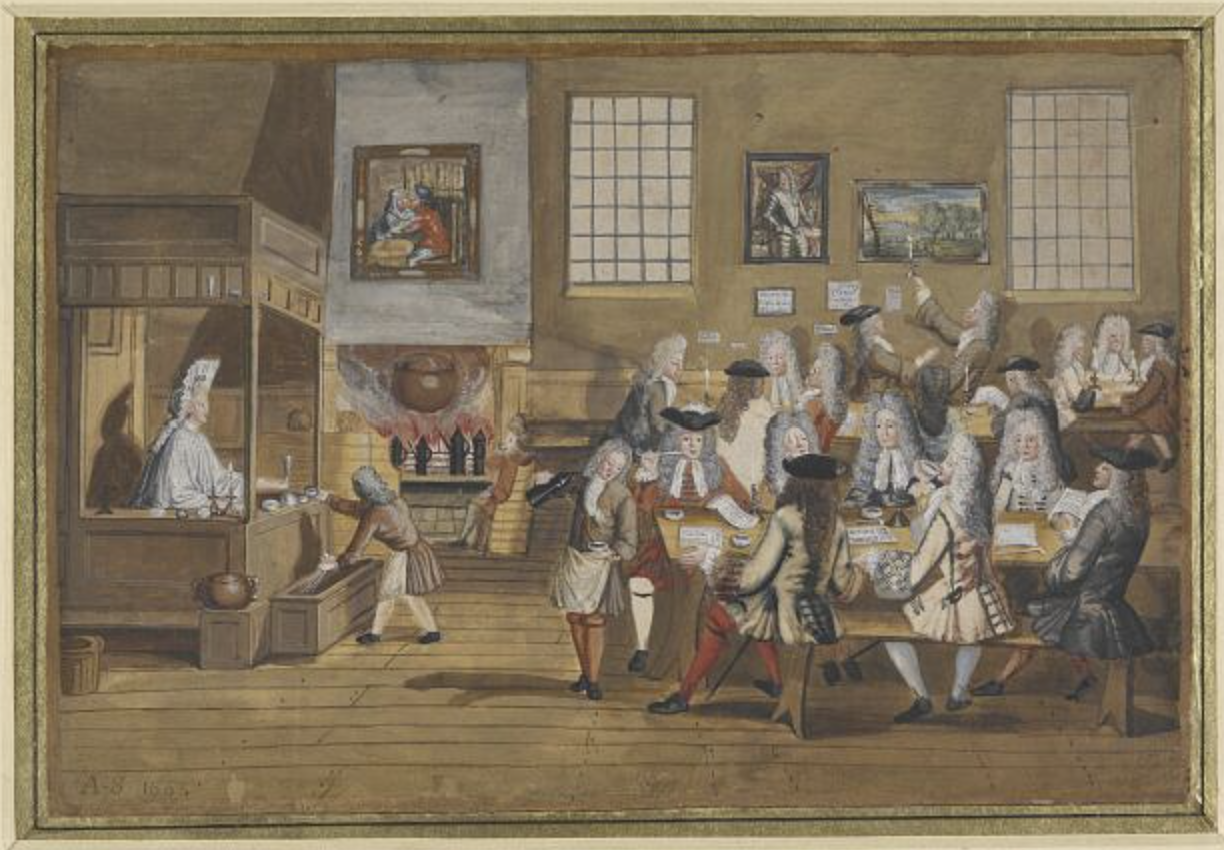
It's a foggy room, full of smoke and men in wigs. They drink from wide shallow bowls with no handles, held in both hands, because the cup with a handle has not arrived yet; a serving of coffee was a "dish," and that is the word they used for it. A boy carries a pot between the tables. Someone reads the newspaper out loud to the bench. At the far end a woman works the coffee urn, because the houses full of men were very often run by women.
Nothing in this picture needs a caption.
You have been in this room. The shared paper, the small tables, the person talking a little too loudly in the corner, the smell, the hum, the hour that gets away from you. Three hundred years lie between you and that bench, and the café did not change, because we did not change. We still go somewhere that is not home and not work to drink a hot bitter cup and be among people while we think.
Language: five small things to keep
The drink and the room left words all over English. Five to carry out with you.

Coffee. It crossed three empires to reach that shed: Arabic qahwa (KAH-wah), an old word once used for wine, borrowed for the new black drink; Turkish kahve (kah-VEH); Dutch koffie; then English. Say them in order and you can hear the trade route. The word is a small map.
Café, caffeine, cafeteria. From that same root the drink grew a family. The French took café for both the cup and the room; the chemists cut caffeine out of the bean; the Americans built the cafeteria. One old word for wine, and three centuries later it names your whole afternoon.
A dish of coffee. (A dish, not a cup.) In the painting they drink from handle-less bowls, so a serving was a dish, and the posted house rules fined a brawler "a dish t' atone the sin." Next time you cradle a wide latte bowl in two hands, you are holding the older shape.
Penny university. The name the customers gave the thing themselves. Not a scholar's coinage, not a historian's label. A joke that told the truth: for the price of the cheapest coin, you got an education in whatever the next table happened to know.
Lloyd's. A man sold coffee near the docks and kept a list of ships for his patrons. He has been dead three hundred years. His name is still lit over the largest insurance market on earth, insuring the ships, and the planes, and probably your house. The coffee wore off. The name did not.
History again: the dolphin on the table
Go back to the Grecian, the scholars' house by the law courts, because the best story in London happened there.
The Royal Society, England's great company of scientists, met nearby, and when the meeting broke up the members walked to the Grecian to keep arguing over coffee. Isaac Newton drank there. So did Edmond Halley, who reckoned the comet. So did Hans Sloane, whose collection became the British Museum. The most important science of the age spilled out of the official rooms and into the coffeehouse, where it got loud.
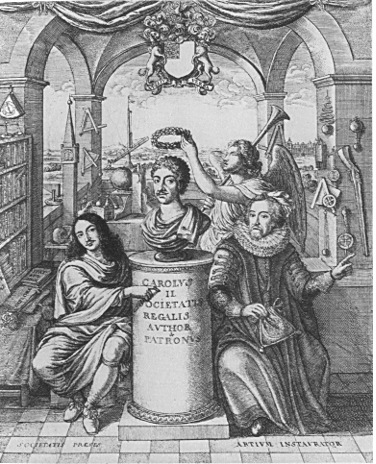
One afternoon, the story goes, they brought in a dolphin.
They laid it on a table among the coffee dishes and dissected it, then and there, to see how the animal was built. Fellows of the Royal Society, sleeves up, opening a dolphin in a café, because they were curious and the light was good and the coffee was hot.
That is the whole of it, in one room.
For a penny, a boy off the street could have walked in, taken the next free seat, and watched Isaac Newton's friends take a dolphin apart. Nobody would have moved him along. Nobody would have asked his father's name. The seat was his for the coin and the argument was his for the listening, and that was the revolution nobody announced. Not the coffee. Not the buildings. Not the famous names.
The seat.
Anyone's, for a penny.
Remember what you've learned
No exam. Nobody is taking attendance, and nobody did then either; the men on those benches had wandered in off the street for the price of a coffee, which is the only enrollment that ever counted, and it is the one you just paid.
Before the cup goes cold, open the commonplace book. Keep Addison's line about philosophy leaving the closet, or the rule about taking the next free seat, or the dolphin, or whichever thing wants keeping. The crossword and the essay are in the kit, for tonight or another evening. We remember what we ask ourselves.
Make it fun!

Subscribe for more, and your commonplace book will begin to fill.
Come be curious with me.
Your fellow student,
K. Larkin
PS: Remember to mark this lesson complete for your progress to show.
A desk of your own, filling lesson by lesson
Your lantern, your shelf, your progress
What is in the kit
Keep the lamp lit
Every lesson here is free, and stays free, because patrons pay for the wax that keeps the candles lit. Become a patron or founder to download the printable kit and the Anki deck, and to be the reason the next reader finds all of this open and free.
The lamp stays lit because you fill it.
Your study kit
Yours because you keep the lamp lit. Print it, work it, keep it.