Romanticize Learning
In this lesson
- A small ritual to beginHow to read this: a candle, some Chopin, a pen.
- Music: Frédéric ChopinThe exile who left his heart in Warsaw.
- Art: Joseph Wright of DerbyA painting of the instant wonder strikes.
- Literature: Walt WhitmanLeaving the lecture to look up at the stars.
- Philosophy: Viktor FranklWhy a why can carry you through almost anything.
- Language: five small things to keepFive words worth keeping, żal among them.
- History: Marie CurieThe whole of her, and what it cost.
- Remember What You've LearnedOne candle, no grade, and what to do next.
Read one part at a time. Press Next when you are ready.
Paris, 1891.
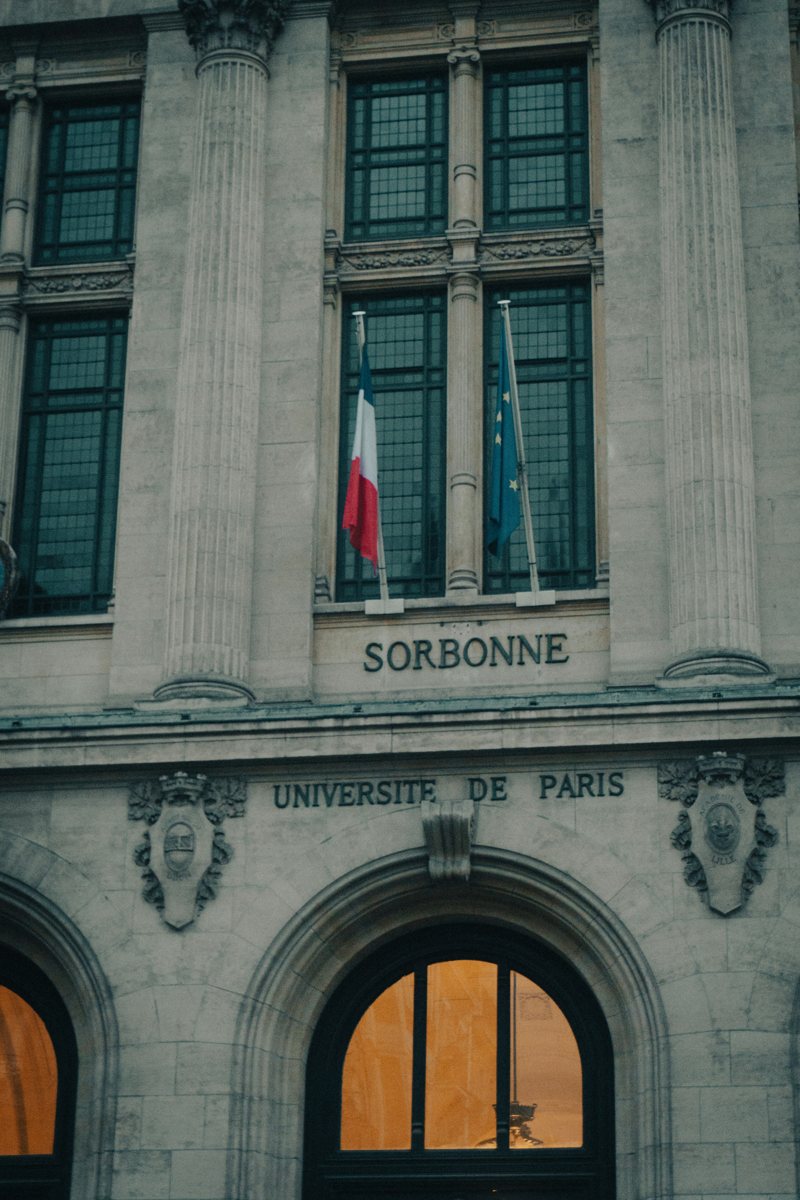
A young woman climbs to a garret near the Sorbonne, so cold that in winter she piles every dress she owns on top of the blanket and still shivers through the night. Some evenings she faints from hunger. She has one chair, one lamp, and a little coal when the money stretches.
She is twenty-three, and she has never been happier.
A small ritual to begin
Set the scene. Light a candle, make the tea. Print out the PDF version if you can, grab a real pen and a real notebook, and put the phone in another room. You are enrolling, tonight, in the Flying University of one.

Put on Chopin. The Nocturne in E-flat, Op. 9 No. 2, if you want somewhere to start. Let it fill the room while you read.
Learn by writing. As you read on, take notes. Copy out anything that stops you, in your own handwriting. When we write by hand instead of typing, we remember more and understand more deeply; the researchers who proved it titled their study "The Pen Is Mightier Than the Keyboard."
Read with a pen. Talk back in the margins. Underline the line that stops you; put a star beside what you love, a question mark beside what you doubt, a word of your own next to a word of theirs. This is what people used to call marginalia, and there is nothing precious about it: the books we treasure most are the ones we wrote in. (In the printable version there is a column down the right for exactly this.)
The slowness is not in the way; the slowness is the point.
What is in the kit
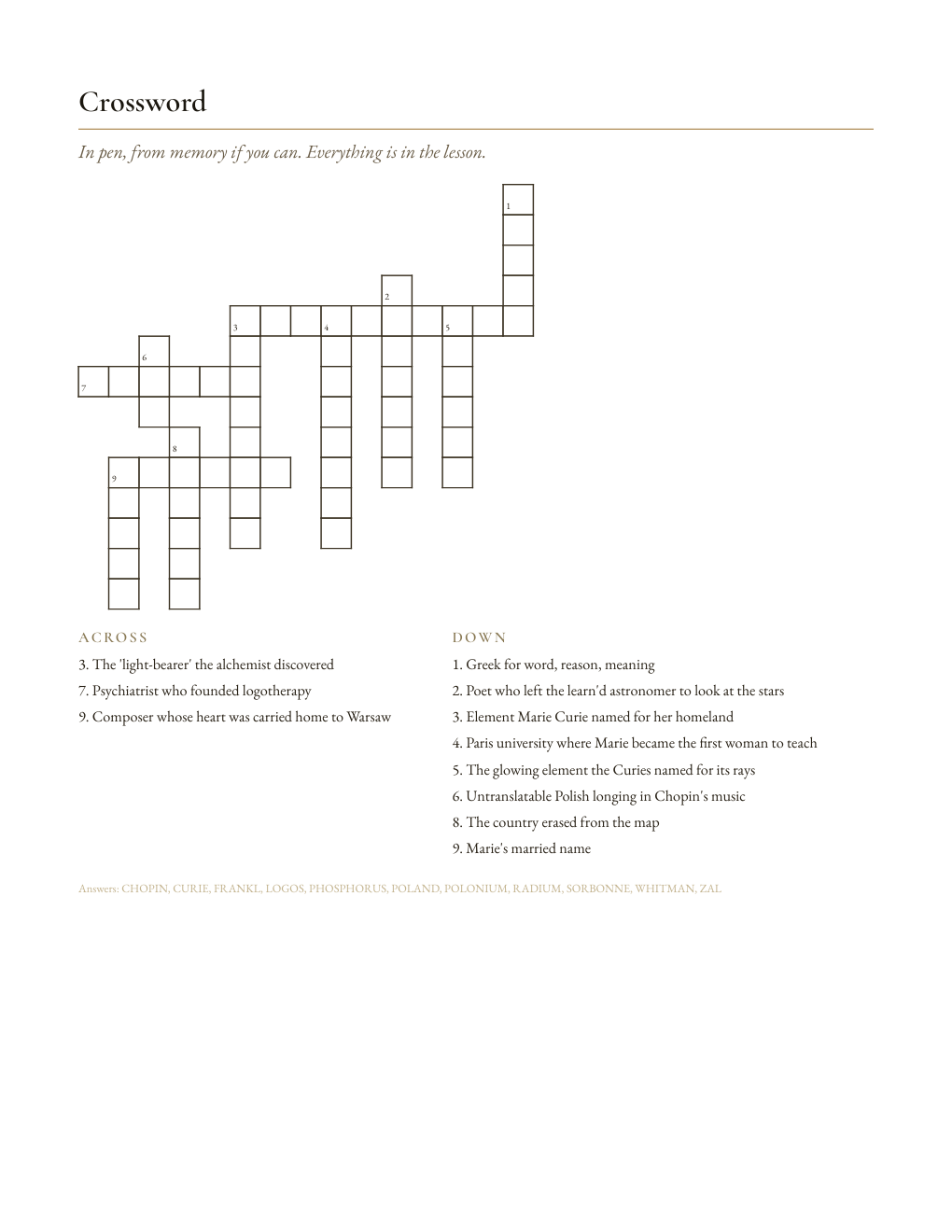
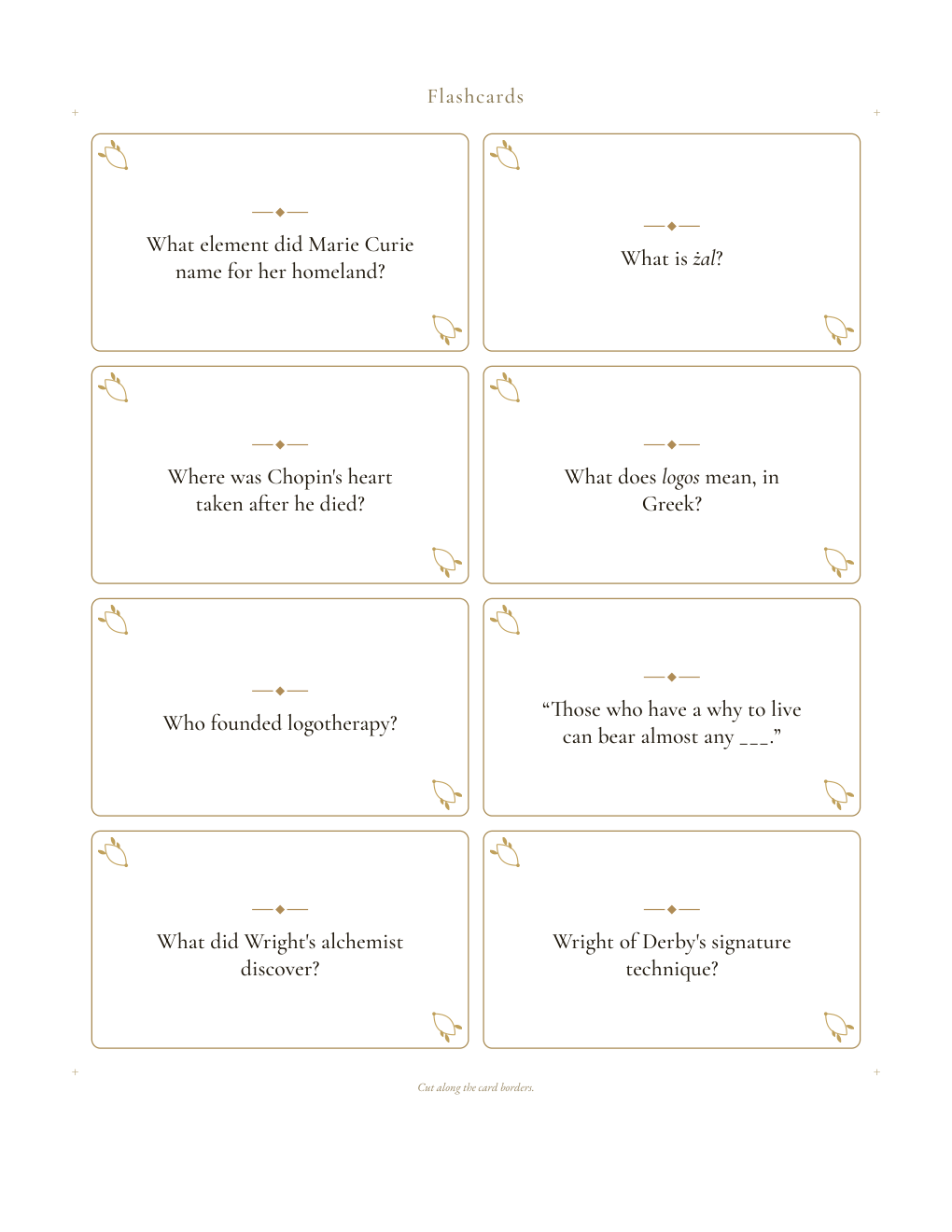
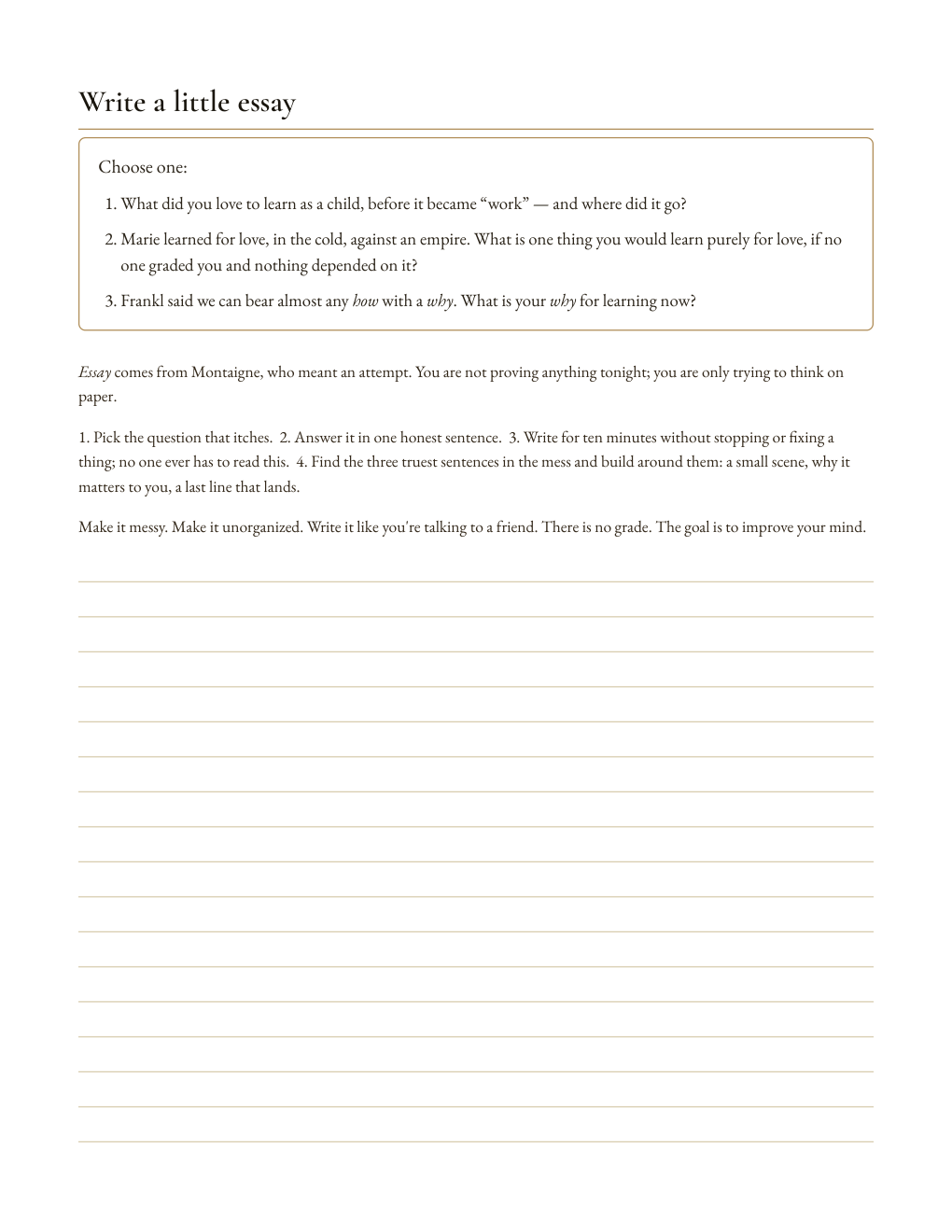
Keep the lamp lit
Every lesson here is free, and stays free, because patrons pay for the wax that keeps the candles lit. Become a patron or founder to download the printable kit and the Anki deck, and to be the reason the next reader finds all of this open and free.
The lamp stays lit because you fill it.
Your study kit
Yours because you keep the lamp lit. Print it, work it, keep it.
Music: Frédéric Chopin
That music in the room belongs here with that young girl named Marie Curie.
Chopin left Warsaw in 1830, at twenty, a frail young pianist bound for the wider world. He was barely gone when the city rose up against Russian rule. The uprising failed, the way they all failed; the Russians took Warsaw back and made it pay. Chopin got the news far from home, and something in him broke and hardened in the same moment: he never returned. To go back would have meant living under the boot that had crushed his friends.
So he stayed in Paris, an exile, for the rest of his short life, and he mourned his lost homeland through music. His mazurkas and polonaises are Polish dances made immortal. There is a word the Poles use for this ache inside them, żal, and it has no clean translation.
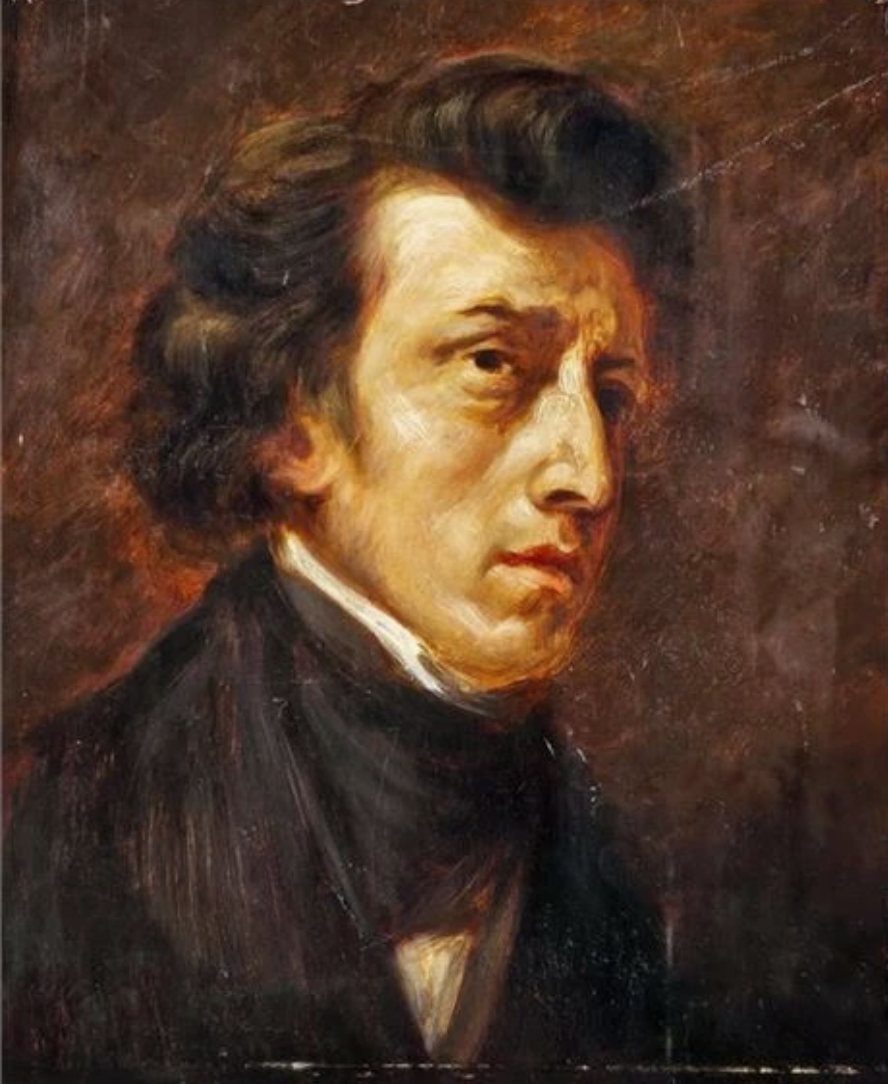
When Chopin died at thirty-nine, he asked that his heart be cut from his body and carried home to Warsaw. It was. It rests there still, sealed inside a church pillar, while the rest of him lies in Paris.
His heart was always with his homeland.
Maria, in her garret, dealt with the same erased Poland and the same exile's love. He smuggled his heart home after his death; she would smuggle her homeland into the periodic table.
Two Poles in Paris, learning and making for love of a place Russia tried to erase.
History: The Flying University
Her name was originally Maria Skłodowska, and her country had been erased.
Poland had been carved up and swallowed by its neighbors: Russia, Prussia, and Austria. For more than a century there was no Poland at all, only provinces of other people's empires. Warsaw, where Maria was born, belonged to the Tsar. After a failed uprising, the Russians set out to finish the erasing: the Polish language pushed out of the schoolrooms, the history rewritten, the universities shut to any Pole who would not bend, and shut to women entirely.
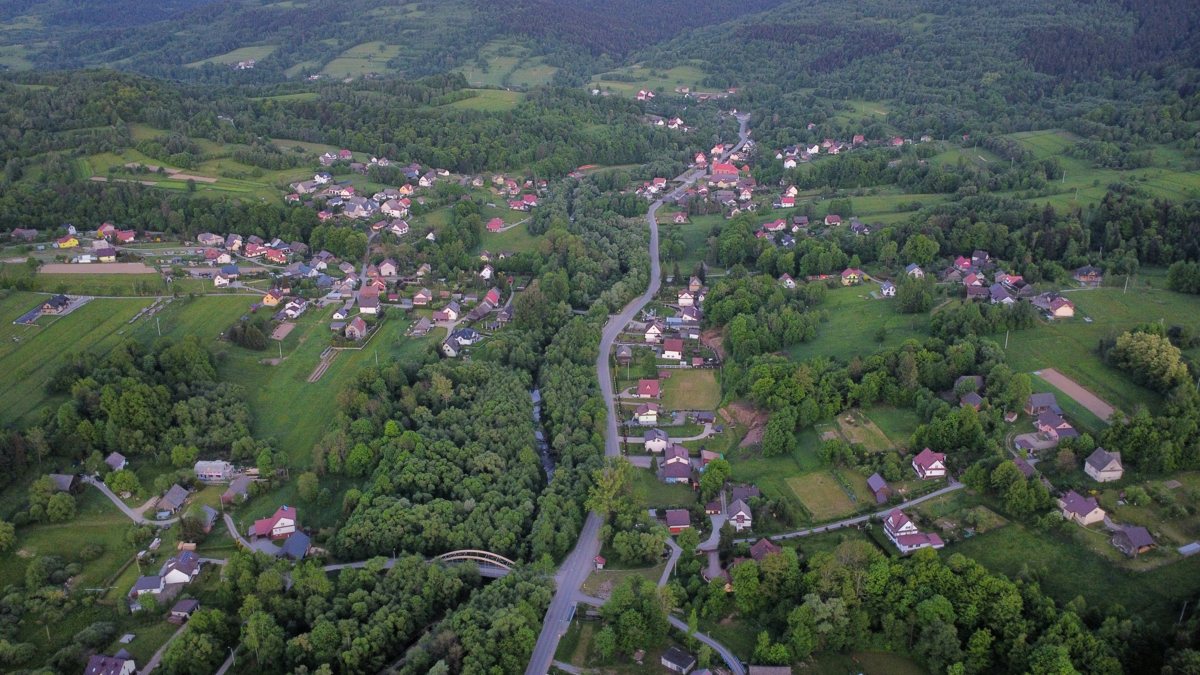
So the Poles built a university of their own, in secret.
They called it the Flying University, because it never stayed still. Classes met in private flats and moved from address to address to stay ahead of the police. No diplomas, no halls, no permission. Only teachers who risked prison and students who came anyway, at night, to learn physics and history and the philosophy their rulers had forbidden them. Many of them were women. Maria was one.
And even that was not enough to reach Paris. To pay for it, she spent years as a governess in the Polish countryside, sending her wages to her sister Bronya, on a pact: Bronya would study first, then send for her. Maria taught other people's children by day and read her own books late into the night. She did not get her turn until she was twenty-three.
She learned in secret, in poverty, in a language her rulers were trying to kill.
She chose learning, again and again, risking her freedom.
That is the whole secret, and we have mostly forgotten it. Somewhere along the way we were taught that learning is work: a thing done for a grade, a test, a line on a form.
Maria learned the other way: for love and freedom and opportunity.
In the cold.
The girl in the freezing garret would go on to win two Nobel Prizes and become the first woman ever to teach at the Sorbonne.
Art: Joseph Wright of Derby
Take your time and enjoy this painting. What do you notice first? When you look longer, what details draw your eye? How does it make you feel? What does it make you think?
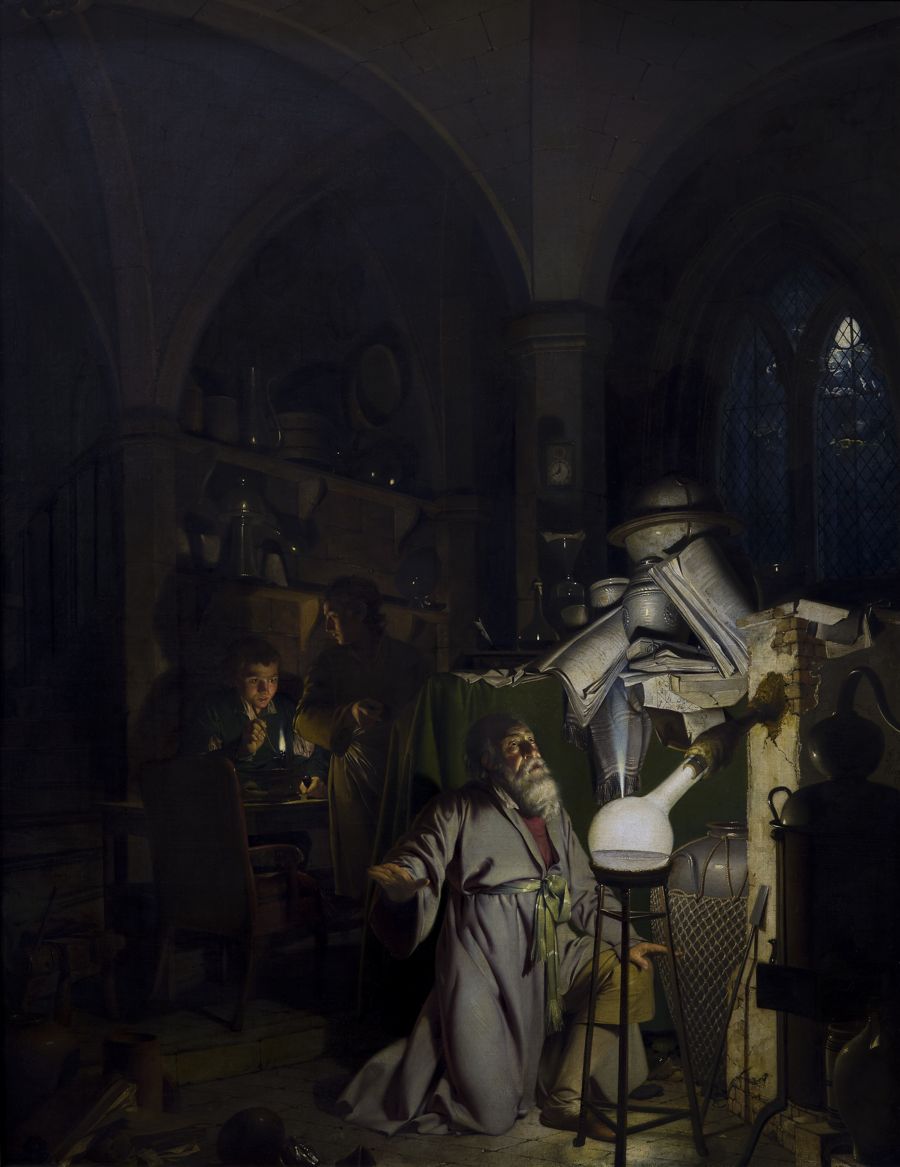
It is by Joseph Wright of Derby, an English painter who died in 1797, and it shows an old alchemist on his knees. He had spent his life chasing the philosopher's stone, the fabled recipe for turning base metal into gold. He never made gold, but he painted light. The flask before him glows, cold and white and strange, and the old man has thrown up his arms in the pose painters once saved for saints receiving a vision.
Look at how Wright lights it: almost the whole canvas is black; the only true light in the room is the glow itself, rising out of the glass and falling on the man's face and hands.
This was Wright's signature, the thing nobody did better: a single hidden source of light in a field of darkness, so the picture seems lit from within. He took the trick from Caravaggio and the old Dutch candlelight painters and turned it on the new marvels of science.
He may be the first great painter to treat a laboratory the way earlier artists treated a cathedral.
A hundred and thirty years later, Marie Curie would lie in bed and watch her radium glow in the dark, and feel the very same thing.
Literature: Walt Whitman
Read this one out loud. It is short, and it wants to be heard.
When I heard the learn'd astronomer,
When the proofs, the figures, were ranged in columns before me,
When I was shown the charts and diagrams, to add, divide, and measure them,
When I sitting heard the astronomer where he lectured with much applause in the lecture-room,
How soon unaccountable I became tired and sick,
Till rising and gliding out I wander'd off by myself,
In the mystical moist night-air, and from time to time,
Look'd up in perfect silence at the stars.
— Walt Whitman, 1865
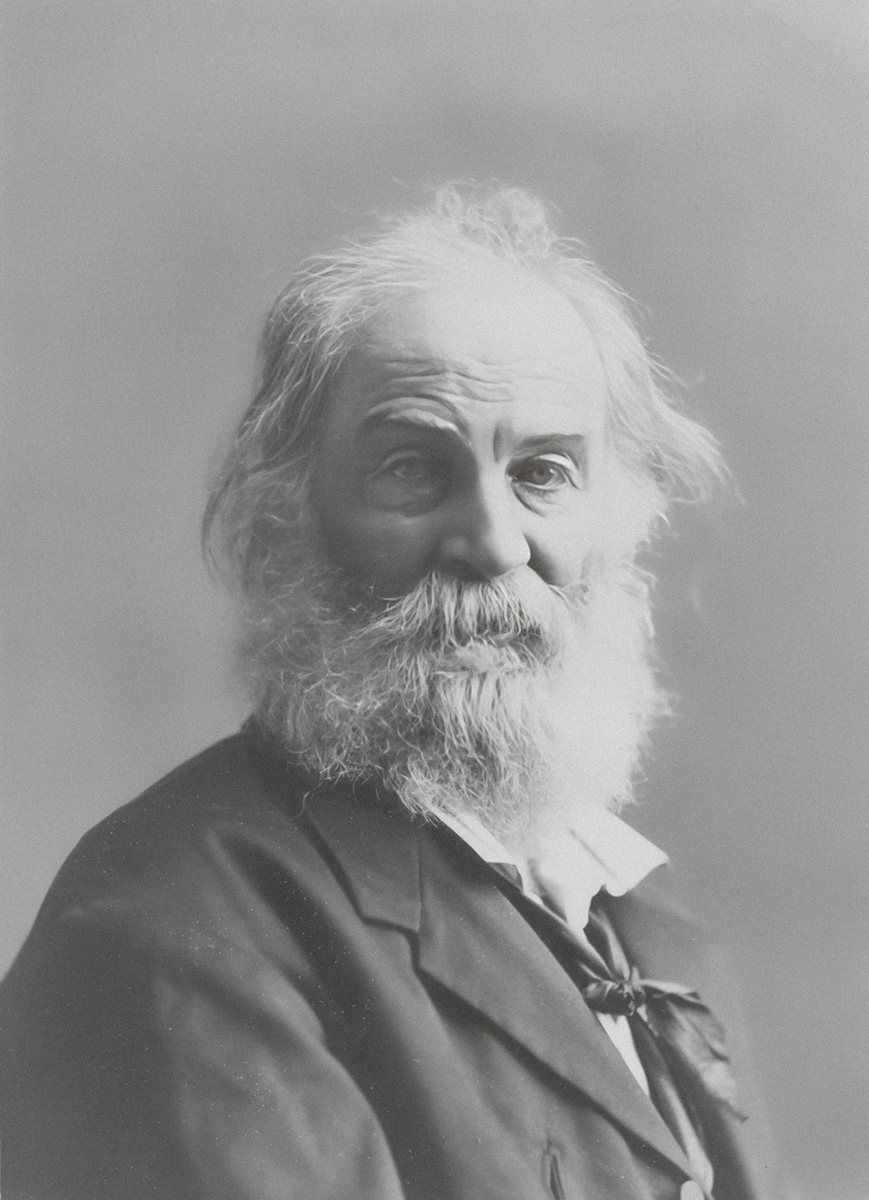
Watch what the poem does with its own length. The first four lines pile up, each starting the same way: when, when, when, until you feel the whole weight of that lecture-room: the proofs, the figures, the columns, the charts, the applause. The lines are long and crowded on purpose.
They are built to tire you, and they do; the fifth line says so out loud, "tired and sick."
Then the sentence turns. He rises, he glides out, he wanders off, and the words go quiet and loose in his mouth. The poem ends not on a fact but on a silence: "in perfect silence at the stars," the shortest true thing in it.
Whitman is not against learning.
He is against the kind that has forgotten why it began. The astronomer has all the figures and none of the sky. That is the exact trade this lesson is asking you to undo: not to throw away the knowing, but to carry it back outside and look up and wonder at the stars.
Philosophy: Viktor Frankl
Viktor Frankl was a young Viennese psychiatrist when the Nazis sent him to the camps. He survived; most of his family did not. He came out carrying one idea he had watched keep people alive.
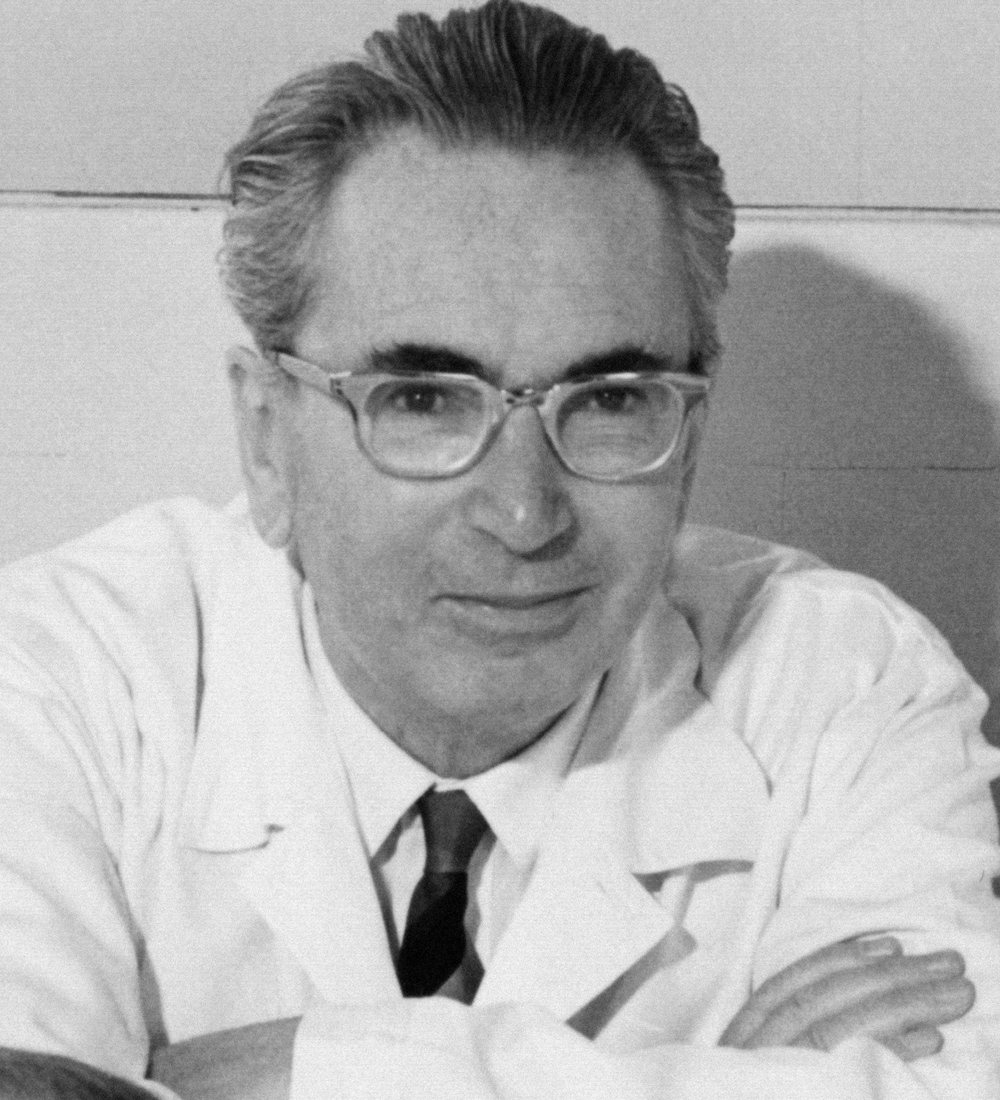
He called his method logotherapy, from logos, the Greek word for meaning. Freud had taught that the deepest human drive was pleasure; others said it was power. Frankl, who had seen a man give away his last crust of bread for a friend and others endure the unendurable for the sake of a person or a piece of work waiting on the outside, said it was neither.
Frankl said what we want most is meaning.
"Those who have a why to live," he wrote, borrowing the line from Nietzsche, "can bear almost any how." He had watched it prove true in the worst place on earth. The ones with a reason outlasted the ones who had only had their comforts taken away.
And this one is his own, worth copying by hand: "Everything can be taken from a man but one thing: the last of the human freedoms, to choose one's attitude in any given set of circumstances."
Marie had a why. It carried her through the hunger and the locked doors and the long grey Paris winters. Her own line, the one worth keeping forever, is this:
"Nothing in life is to be feared, it is only to be understood."
Language: five small things to keep
In 1898 Maria, now Marie, discovered a new element, and she gave it a name. She called it polonium (say it puh-LOH-nee-um), after Polonia, the old Latin name for the Poland that no longer showed up on any map: a scientist smuggling her lost homeland into the periodic table, where no empire could ever take it out again.
Polonium is a metal, and one of the most fiercely radioactive things on earth. Marie and her husband Pierre found it by hand, boiling and sifting tons of black ore in a cold shed, chasing a faint impossible energy no one could yet explain. It was the first new element she ever pulled out of the dark, and she named it for Poland before she could even prove it was real.
Kto pyta, nie błądzi. (ktoh PIH-tah, nyeh BWON-jee.) "He who asks does not go astray." A whole philosophy of curiosity in four words: the question is not a weakness, it is the way through.
Żal. (zhahl.) The untranslatable Polish longing, the ache in Chopin's music: grief and love, together, for a thing you have lost and cannot stop reaching toward.
Logos. (LOH-gos.) Greek for word, reason, meaning. It hides inside nearly every subject you could ever study: bio-logy, geo-logy, psycho-logy; that -logy is this word, the study or the account of a thing. It is the root of Frankl's logotherapy, the healing that comes through meaning. Learning, in the end, is just the love of logos: the long search for the word behind the world.
Phosphorus. (FOS-fer-us.) From the Greek phosphoros, "light-bearer." It was what Wright's old alchemist found in the dark in place of gold, and the same root still glows inside our word for light. He went looking for riches; he found a way to see.
History: Marie Curie
By now you have met her in pieces: the girl in the garret, the exile's love she shared with Chopin, the glow she would chase like Wright's alchemist, the why that Frankl says can carry a person through anything. Here is the rest of her.
In Paris she met a quiet physicist named Pierre Curie, married him, and the two of them went hunting for the source of the strange rays coming off certain rocks. They found two new elements. The second they named radium, for the way it gave off light. They had no proper laboratory, only a leaking shed with a bad roof, and there, night after night, Marie stirred vats of boiling ore by hand until she was thin and grey with exhaustion.
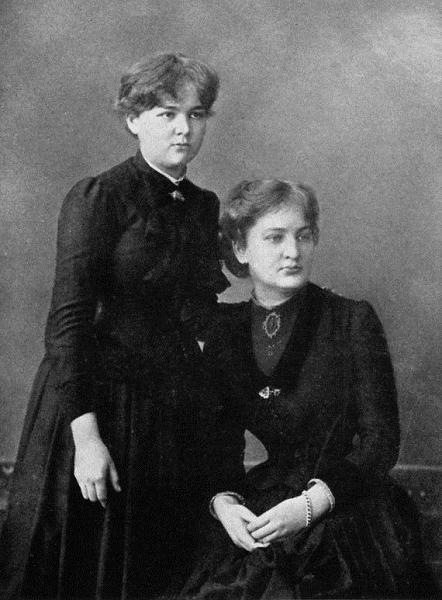
In 1903 she and Pierre won the Nobel Prize in Physics. Then Pierre was killed in the street, and she took over his lectures and became the first woman ever to teach at the Sorbonne. In 1911 she won a second Nobel, this one in Chemistry, alone. No one had done it before. Almost no one has since.
The glow she loved was killing her the whole time. She carried tubes of radium in her pockets and kept them by her bed to watch them shine, never guessing the light was poison. It took her slowly, and in 1934, she died. Her notebooks are still so radioactive that they are kept in lead-lined boxes; to read them, you sign a waiver and put on gloves. A hundred years on, her curiosity is still, faintly, giving off light.
She chose learning in the cold, against an empire that wanted to keep her obedient and uneducated, at the cost of her life.
Remember what you've learned
For your brain health and the pure love of learning! Hopefully you understand one more thing tonight than you did this morning, and hopefully, you're curious about the next.
Before you blow out the candle, open your commonplace book and write down the things you don't want to lose. Do the crossword and essay today or another day. We retain things better if we quiz ourselves and handwrite things, and we think better if we write essays.
Make it fun!

Subscribe for more, and your commonplace book will begin to fill.
Come be curious with me.
Your fellow student,
K. Larkin
PS: Remember to mark this lesson complete for your progress to show.
A desk of your own, filling lesson by lesson
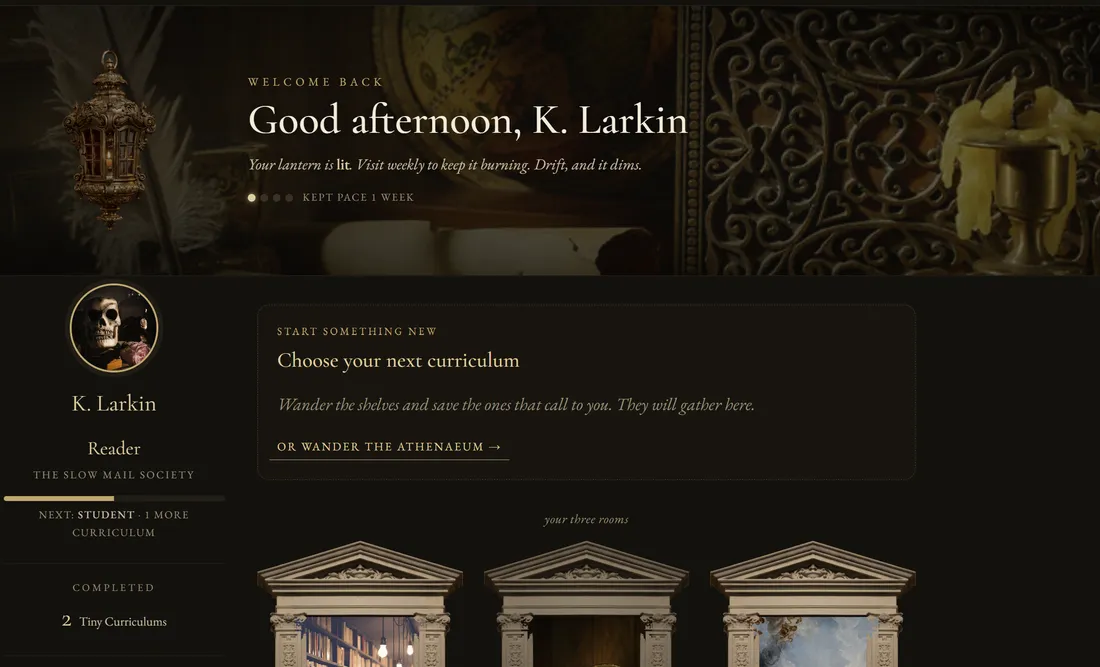
Your lantern, your shelf, your progress
What is in the kit
Keep the lamp lit
Every lesson here is free, and stays free, because patrons pay for the wax that keeps the candles lit. Become a patron or founder to download the printable kit and the Anki deck, and to be the reason the next reader finds all of this open and free.
The lamp stays lit because you fill it.
Your study kit
Yours because you keep the lamp lit. Print it, work it, keep it.